


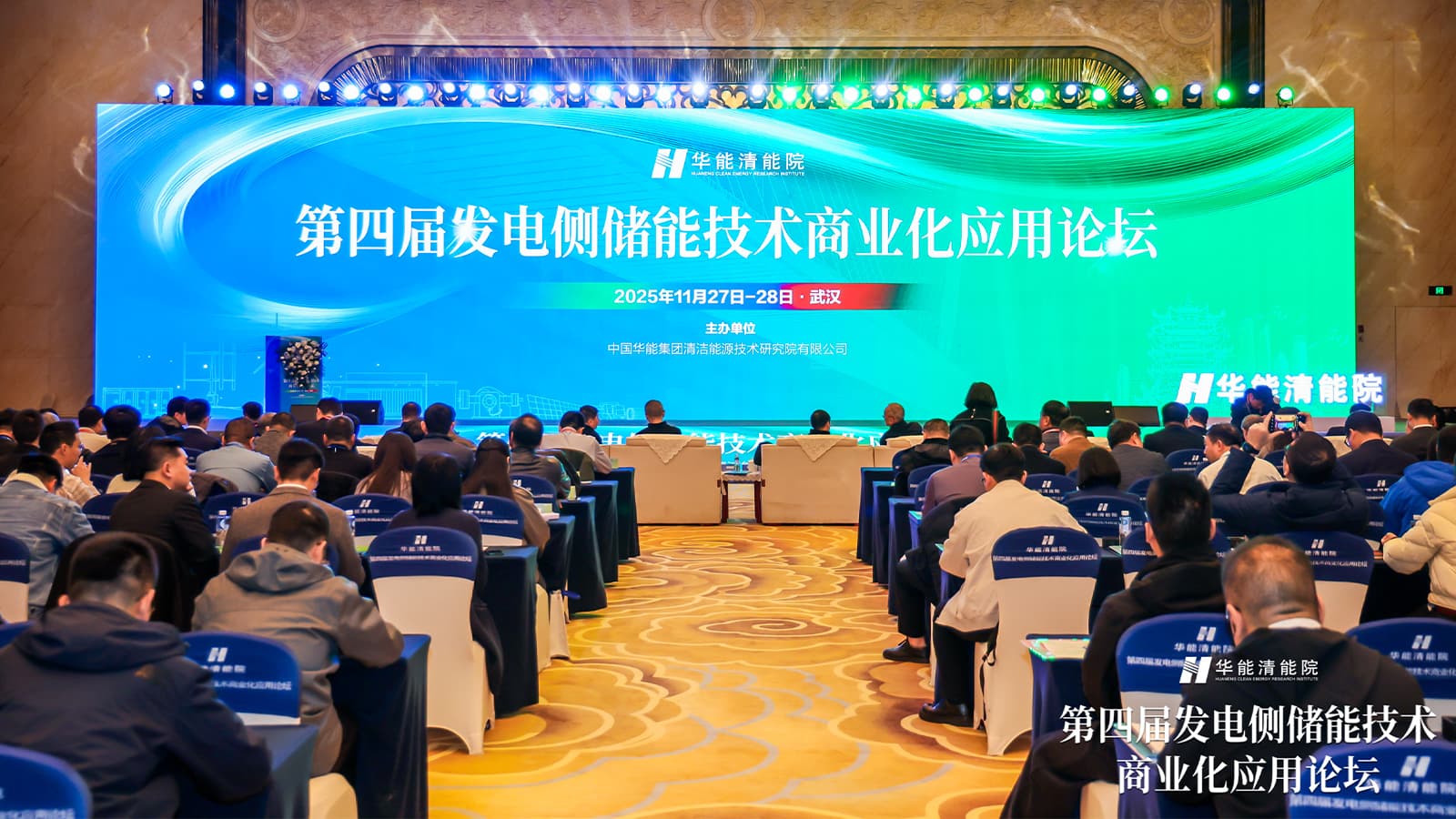
November 27-28, 2025, the 4th Power-Side Energy Storage Technology Commercialization Forum, hosted by China Huaneng Group Clean Energy Technology Research Institute Co., Ltd. (Huaneng CETI), was held in Wuhan, Hubei. Guangzhou Zhiguang Energy Storage Technology Co., Ltd. (Zhiguang Energy Storage) was invited to attend the event, joining industry peers to review storage achievements, share development insights, and explore future trends in the sector.
Jiang Xinyu, President of Guangzhou Zhiguang Electric Co., Ltd. and Chairman of Zhiguang Energy Storage, delivered a keynote speech titled “Breakthroughs in Key Technologies of Cascaded High-Voltage Grid-Forming Energy Storage Systems and Their Multi-Scenario Applications.” Jiang reviewed the joint R&D efforts between Zhiguang Energy Storage and Huaneng CETI in developing and rapidly industrializing 35kV high-voltage, large-capacity energy storage technologies. He also presented Zhiguang’s innovations in cascaded high-voltage grid-forming storage technology and its large-scale application in frequency regulation.
1. Cascaded High-Voltage Direct-Connected Energy Storage: Technological Innovation and Application for Grid-Forming Scenarios
01 Technical Background: “Dual-High” Power System Trends Driving Storage Technology Upgrades

As China’s wind and solar power installations exceed the 100-GW scale, the high penetration of renewables and high-power electronic equipment is reshaping power system characteristics. Jiang noted: “Traditional grid-following storage can only passively respond to commands and cannot address critical issues such as inertia deficiency and frequency instability caused by renewable variability.”
On the policy front, the National Development and Reform Commission and the National Energy Administration released the Special Action Plan for the Large-Scale Development of New Energy Storage (2025–2027), setting a target of over 180 million kW of new-type storage installations by 2027 and driving an estimated RMB 250 billion in direct investment. The plan also emphasizes expanding new energy storage applications across power generation, transmission, distribution, and multi-scenario integration, and promoting grid-forming storage demonstrations in high-renewable, weak-grid, and isolated-grid environments.
Jiang stressed that the generation-side—crucial for renewable energy consumption—urgently requires grid-forming storage systems capable of active support and enhanced grid stability. This, he said, has become a central direction for industry-wide technological advancement.
02 Core Technological Breakthroughs: Building System-Level Competitiveness

Jiang highlighted Zhiguang’s key breakthroughs in cascaded high-voltage grid-forming storage systems:
Virtual Synchronous Generator (VSG) Control:
By emulating synchronous machine characteristics such as inertia and internal EMF, VSG enables power electronic converters to exhibit synchronous generator–like voltage and frequency behaviors.
Self-Synchronizing Voltage Source Control:
Featuring constant internal potential and adaptive virtual admittance transient control, the system supports frequency and voltage stability without fault detection. It allows online inertia tuning from 1–20 seconds, stable operation under SCRs of 1.1–20, reactive short-circuit current response within 20 ms, and configurable wide-band damping.
03 Technology Route Comparison: Clear Advantages of Cascaded High-Voltage Direct-Connected Grid-Forming Solutions

Jiang compared cascaded high-voltage large-capacity systems with traditional low-voltage solutions. Unlike low-voltage storage, Zhiguang’s high-voltage direct-connected technology offers larger unit capacity and connects directly to 35kV renewable collection grids without transformers. Its short electrical distance to the grid enables stable support across a wide SCR range, enhancing transient and steady-state performance—making it an ideal technical path for grid-forming storage.
Drawing on multiple benchmark projects, Jiang demonstrated the technology’s effectiveness across various applications. He emphasized: “Cascaded high-voltage grid-forming storage is not just a technological upgrade—it represents a system-level innovation. Zhiguang is committed to working with industry partners to promote the standardization and large-scale deployment of this technology, contributing to a safer, more stable, and more efficient new power system.”
2. Frequency Regulation Performance: Commercial Validation of Technological Value
Zhiguang’s cascaded high-voltage direct-connected energy storage system has also demonstrated strong performance in grid frequency regulation. With a charge–discharge cycle efficiency above 92% and “faster-by-one-second, more-accurate-by-one-degree” frequency control capability, the system delivers rapid response to frequency deviations and precise power adjustments during primary and secondary frequency regulation, significantly reinforcing grid resilience and security.

The commercial value of this technology has been fully validated at the Bai Temple (Baimiao) Independent Energy Storage Station in Qingyuan, Guangdong. Owing to its exceptional profitability, the station has become a widely recognized industry benchmark and has received more than 1,000 external visits to date.
These results show that cascaded high-voltage direct-connected energy storage not only serves as a “technical vanguard” for grid security but also acts as a “profit engine” generating sustainable returns for investors—providing a successful blueprint for the commercialization of large-scale standalone storage stations.

Although the renewable energy industry faces both opportunities and challenges, the gathering of stakeholders in Wuhan demonstrated a shared determination to advance technological innovation. Only through continuous progress in core storage technologies and breakthroughs across multiple technical pathways can the industry accelerate the development of a new power system centered on renewable energy and build greater momentum toward the national dual-carbon goals.
